> For the complete documentation index, see [llms.txt](https://docs.millpont.com/llms.txt). Markdown versions of documentation pages are available by appending `.md` to page URLs; this page is available as [Markdown](https://docs.millpont.com/meti-operative-documents/source-rulebook-v0.9.md).
# Source Rulebook (V0.9)
**Content**
1. [OVERVIEW](#id-1.-overview)
2. [GOVERNANCE AND OVERSIGHT](#id-2.-governance-and-oversight)
3. [GUIDING PRINCIPLES](#id-3.-guiding-principles)
4. [CUSTODIAN RESPONSIBILITIES AND REQUIREMENTS](#id-4.-custodian-responsibilities-and-requirements)
5. [SOURCE LEDGER AND DATA SUBMISSION REQUIREMENTS](#id-5.-source-ledger-and-data-submission-requirements)
6. [CHAIN OF CUSTODY DOCUMENTATION REQUIREMENTS](#id-6.-chain-of-custody-documentation-requirements)
7. [ANNUAL COMPLIANCE VERIFICATION](#id-7.-annual-compliance-verification)
8. [DATA SECURITY AND OPERATIONAL INTEGRITY](#id-8.-data-security-and-operational-integrity)
9. [SSID CONFLICT RESOLUTION PROCESS](#id-9.-ssid-conflict-resolution-process)
10. [RULEBOOK GOVERNANCE ](#id-10.-rulebook-governance)
11. [RULEBOOK UPDATE PROCEDURES](#id-11.-rulebook-updates-procedures)
## 1. OVERVIEW
### **1.1.** **Purpose**
**(a)** A core document of the MillPont Environmental Trust Infrastructure ("METI") clearinghouse platform, the METI Source Rulebook (the “Rulebook”) outlines the guidelines and protocols that govern the operations of the METI Source Ledger (“MSL”). The MSL is designed to provide a verifiable and transparent means for managing Secure Source Identifiers (“SSIDs”) tied to Environmental Attribute Certificates (“EACs”) across independent attribute tracking systems and critical font- and back-office operations in various agricultural commodities and value chains.
**(b)** The Rulebook incorporates over two decades of best practices in environmental attribute tracking, aligned with both the [International Attribute Tracking Standard](https://www.trackingstandard.org/the-standard/) (“IATS”) and [the Commodity Futures Trading Commission's (“CFTC”) No Double-Counting Guidance](https://www.federalregister.gov/d/2024-23105/p-440) to prevent duplicative claims and double issuances of EACs. Through the MSL, METI enables Market Participants to securely submit, verify, and manage geospatial, temporal and attribute data, ensuring each source is uniquely registered, comparable and traceable through the EAC lifecycle in compliance with global standards for data accuracy, non-duplication, and operational transparency.
### **1.2. Scope**
This Rulebook applies to all METI Members, partners, and stakeholders involved in data submission, verification, and claim management through the MSL. It covers the full data lifecycle from initial submission to claim verification, including data security measures, periodic audits, and procedures for SSID conflict resolution. The comprehensive approach ensures that MSL represents the highest industry standards for accuracy, non-duplication, and reliable reporting. This Rulebook supplements the METI Terms of Use (“Terms of Use”). In the event of any conflict, the Terms of Use provisions take precedence.
### **1.3.** **General Definitions**
* **Account:** A data store within MillPont Environmental Trust Infrastructure (“METI”) attributed to an Account Holder and used to access, submit, administer, or receive records, data, identifiers, or other information through the METI Platform, subject to the Terms of Use, applicable Rulebook(s), approved role entitlements, and any applicable Operative Documents.
* **Account Holder:** A User or other approved party that has been accepted by the METI Administrator for an Account in METI and is responsible for its own use of the Services and the use of the Services by its Users, Representatives, agents, and authorized designees.
* **Beneficiary:** Has the meaning given in the Terms of Use. For purposes of this Source Rulebook, a Beneficiary is a party that receives, claims, holds, or is entitled to receive Ecosystem Services Rights or quantified environmental benefits conveyed, documented, registered, transferred, or otherwise supported through EACs, SSIDs, or related METI records.
* **Custodian:** Has the meaning given in the Terms of Use. For purposes of this Source Rulebook, a Custodian is a party responsible for the custody, management, and administrative oversight of one or more SSIDs, including issuance, distribution, tracking, and, where applicable, underwriting of EACs associated with those SSIDs. A Custodian must maintain an active commercial agreement with the relevant Source owner, Landowner or Operator, or Beneficiary whose agreement is tied to the relevant Source. A Custodian’s access to create, modify, or administer records in the METI Source Ledger is limited to the rights granted under its Account, applicable agreements, approved entitlements, the Terms of Use, this Source Rulebook, and other applicable Operative Documents.
* **Ecosystem Services Rights:** Has the meaning given in the Terms of Use.
* **Entity:** A legally recognized organization, institution, governmental body, partnership, corporation, association, trust, or individual. Status as an Entity does not itself create a right to access METI, hold an Account, administer SSIDs, or act in any METI role unless approved by the METI Administrator under the Terms of Use, this Source Rulebook, and applicable Operative Documents.
* **Environmental Attribute Certificate or Claim (“EAC”):** Has the meaning given in the Terms of Use. For purposes of this Source Rulebook, an EAC is a market-based instrument or claim record associated with Ecosystem Services Rights or quantified environmental benefits and may be linked to one or more SSIDs to support provenance, chain of custody, traceability, exclusivity, or double-counting controls.
* **Know Your Customer (“KYC”):** The know-your-customer, sanctions, counterparty, beneficial ownership, authority, eligibility, and other diligence or evaluation criteria implemented by the METI Administrator under applicable law, the Terms of Use, good industry practice, or applicable Operative Documents.
* **Labeling Authority:** An organization that establishes standards, methodologies, criteria, or labels for EACs or related environmental claims and determines, validates, certifies, or supports whether EACs or claims conform to those standards.
* **Landowners and Operators:** Has the meaning given in the Terms of Use. For purposes of this Source Rulebook, Landowners and Operators include one or more related individuals or entities that own, operate, control, manage, or hold relevant rights in the Source, the associated Ecosystem Services Rights, or the activities giving rise to an EAC.
* **Local Working Instructions (“LWIs”):** A document or set of documents maintained and adopted by a Custodian that defines operational procedures, data requirements, quality controls, issuance controls, administration standards, and distribution procedures for EACs, SSIDs, or related Source records. LWIs must be consistent with the Terms of Use, this Source Rulebook, applicable Operative Documents, and any relevant standards, methodologies, or scientific requirements.
* **Market Participant:** An Account Holder or other approved party that participates in METI in a role involving SSIDs, EACs, Source records, Ecosystem Services Rights, data submissions, data access, or related transactions. Market Participants may include Landowners and Operators, Custodians, Beneficiaries, MRV Providers, Registries, Labeling Authorities, and other approved participants, as applicable. A Market Participant may designate a third-party agent only in accordance with the Terms of Use and an accepted Declaration of Agency.
* **Member and Membership Status:** A party recognized by the METI Administrator as having satisfied the applicable onboarding, eligibility, agreement, role, and compliance requirements for one or more METI Services. Membership Status reflects the Administrator’s confirmation of a party’s standing for the relevant Services and may be limited, suspended, conditioned, or terminated in accordance with the Terms of Use, this Source Rulebook, and applicable Operative Documents.
* **METI Administrator:** MillPont, Inc., in its capacity as administrator of MillPont Environmental Trust Infrastructure, responsible for administering the METI Platform, implementing applicable Operative Documents, and overseeing the Services in accordance with the Terms of Use.
* **METI Platform:** The digital infrastructure, systems, ledgers, interfaces, services, accounts, tools, and related functionality administered by the METI Administrator for the administration, recording, comparison, exchange, verification, or management of SSIDs, EACs, Source records, and related environmental-claim data.
* **METI Source Ledger (“MSL”):** The electronic accounting ledger within the METI Platform used to record, store, track, compare, and administer data submissions, SSIDs, Source records, EAC linkages, and related claims or metadata. The MSL supports provenance, chain of custody, exclusivity, conflict detection, and double-counting controls for environmental claims and related records.
* **MRV Platform:** A monitoring, reporting, and verification platform, system, tool, or service that collects, validates, analyzes, stores, or reports data related to environmental activities, Sources, SSIDs, EACs, or associated environmental outcomes. An MRV Platform may integrate with the METI Source Ledger where approved by the METI Administrator.
* **MRV Provider:** An Entity that administers or operates an MRV Platform or otherwise provides monitoring, reporting, verification, data collection, validation, audit, or environmental-outcome measurement services related to SSIDs, EACs, Sources, or Source records. An MRV Provider may be part of a Custodian’s organization or may operate as an independent third-party provider, subject to applicable approval, agreements, and role entitlements.
* **Omnibus Custodian:** A Custodian, MRV Provider, or other approved Entity authorized to manage, administer, or oversee one or more SSIDs, EACs, Accounts, or Source records on behalf of another party pursuant to an accepted Declaration of Agency or other written authorization approved by the METI Administrator. An Omnibus Custodian is responsible for its use of METI clearing services on behalf of its principal and remains subject to the Terms of Use, this Source Rulebook, applicable Operative Documents, and any applicable financial, data-integrity, and compliance obligations.
* **Registry:** A database, ledger, platform, or system that records the issuance, ownership, transfer, retirement, redemption, cancellation, or other lifecycle status of EACs or related environmental claims. A Registry may also act as, integrate with, or support a Labeling Authority.
* **Resolution Period:** A timeframe designated by the METI Administrator during which an identified conflict, incompatibility, duplication, overlap, or other issue involving SSIDs, Sources, EACs, or related records may be investigated, corrected, resolved, suspended, escalated, or otherwise administered in accordance with the Terms of Use, this Source Rulebook, and applicable Operative Documents.
* **Secure Source Identifier (“SSID”):** Has the meaning given in the Terms of Use. For purposes of this Source Rulebook, an SSID is a unique, addressable, 16-character digital identifier representing exclusivity over a Source for a defined period of time and a specific type of environmental attribute. SSIDs support provenance, chain of custody, data integrity, traceability, conflict detection, and comparison across approved platforms, workflows, and records.
* **Source:** Has the meaning given in the Terms of Use. For agricultural-based projects, a Source is the point of origin of an EAC and may consist of a single parcel or a group of related boundary polygons treated as one operational field, production unit, or managed area, provided the boundary or boundaries have a) common or coordinated management, b) common land cover or operational use, c) common ownership or operating control, and d) a common project administrator or Custodian.
* **Source Type**: Has the meaning given in the Terms of Use.
Capitalized terms used but not defined in this Source Rulebook have the meanings given to them in the METI Terms of Use. If a definition in this Source Rulebook conflicts with the METI Terms of Use, the Terms of Use control, except where this Source Rulebook expressly provides a more specific operational meaning for use within the METI Source Ledger.
### **1.4. Organizational Structure**
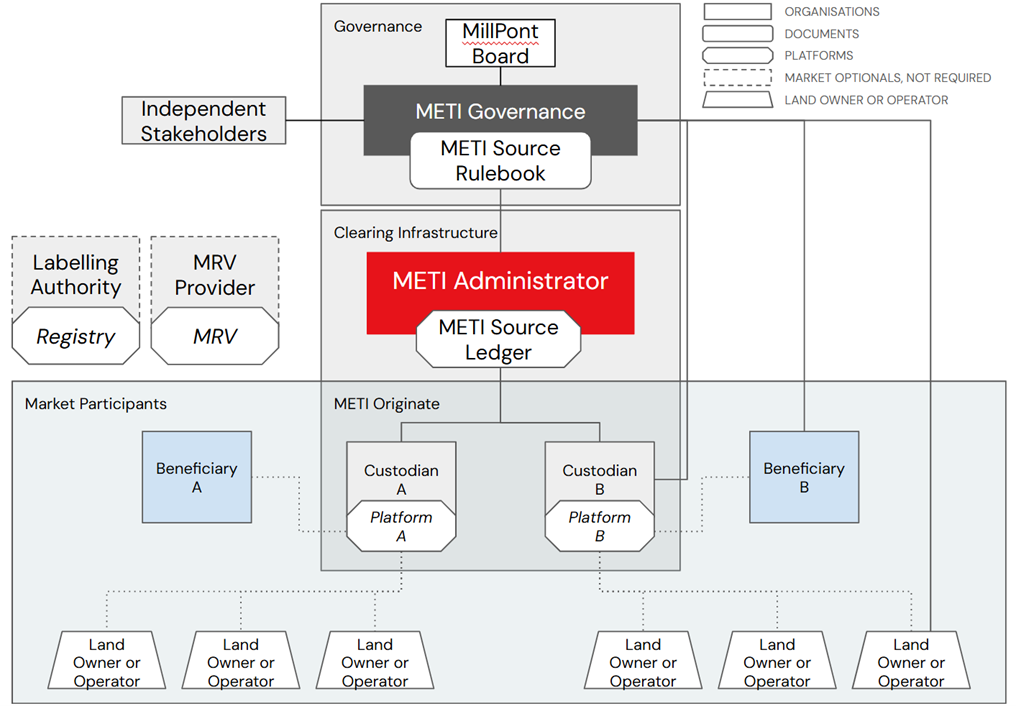
The Rulebook serves as an overarching governance document for METI’s Source Ledger, ensuring consistent application of the platform’s principles and procedures. The governance structure is led by the METI Governance Committee composed of industry stakeholders, METI Originate Members, and independent experts who provide strategic oversight and guidance. This committee plays a crucial role in maintaining the integrity and alignment of the Rulebook with best practices and evolving industry standards. MillPont, Inc., designated as the METI Administrator, is responsible for the practical implementation of the Rulebook’s protocols. MillPont manages the day-to-day operations, ensuring that the Rulebook’s principles, processes, and procedures are applied effectively and are continuously refined to meet the Rulebook’s requirements. This structure supports a collaborative and transparent operational framework that fosters trust and engagement among all METI Members and market participants.
METI Organizational Structure
### **1.5. Alignment with International Standards/Protocols**
These include Greenhouse Gas Protocol (“GHGP”), Science-Based Target Initiative (“SBTi”), Value Change Initiative (“VCI”) Guidance, International Attribute Tracking Standard (“IATS”), ISO 14064-1-4, and the Commodity Future Trading Commission’s (“CFTC”) Guidance on No-Double Counting.
## 2. GOVERNANCE AND OVERSIGHT
### **2.1. Role of METI Governance Committee:**
The METI Governance Committee is comprised of METI Members, industry stakeholders, and independent experts. This governance structure ensures that METI remains aligned with the principles of transparency, integrity, and continuous improvement. This body is responsible for:
#### ***2.1.1. Approving and Amending Processes***
Overseeing updates to the Rulebook and approving new or revised protocols to ensure they are seamlessly integrated into platform operations.
#### ***2.1.2. Advising METI Administrators***
Providing strategic guidance to align METI processes and procedures with evolving standards and best practices.
#### ***2.1.3. Ensuring Fair and Transparent Governance***
Upholding the fairness and integrity of METI operations.
### **2.2. Role of METI Administrators**
METI Administrators, represented by MillPont, Inc., are tasked with maintaining the governance and oversight of METI Platform and the MSL. Their primary responsibilities include:
#### ***2.2.1. Administering Compliance***
Monitoring member activities to ensure adherence to the METI Rulebook/s, Terms of Use, and operational protocols to maintain the platform's credibility.
***2.2.2. Guiding Operational Integrity***
Providing guidance to align operations with industry best practices and adapting to new environmental standards and legal frameworks.
***2.2.3. Facilitating Member Engagement***
Acting as a liaison between METI and its members to address questions, clarify procedures, and support continuous improvement in data submission and record management.
***2.2.4. Dispute Resolution***
Acting as an independent mediator in member disputes as specified by the Terms of Use, relevant Rulebook/s, and applicable contractual agreements.
### **2.3. Oversight Mechanisms**
METI Administrators employ various oversight mechanisms to uphold platform standards, including:
#### ***2.3.1. Routine Audits and Monitoring***
Conducting periodic audits and monitoring member activities to ensure adherence to the Rulebook.
#### ***2.3.2. Data Integrity Protocols***
Protecting the accuracy and reliability of data within the Source Ledger.
#### ***2.3.3. Transparency and Accountability***
Members must support these administration activities by providing documentation and participating in reviews, with METI ensuring the protection of confidential information.
### **2.4. Member Responsibilities**
METI Member responsibilities include:
#### ***2.4.1. Statement of Compliance***
All members of METI, including METI Originate Members, must comply fully with the Terms of Use and this Rulebook.
#### ***2.4.2. Legal Obligations***
Upholding confidentiality, intellectual property rights, and data privacy as outlined by Terms of Use and this Rulebook.
#### ***2.4.3. Data Integrity***
Submitting data that is accurate, complete, and aligned with METI’s rules and procedures to maintain a trusted clearinghouse.
#### ***2.4.4. Transparency***
Ensuring environmental claims are verifiable and contribute to sustainability goals, reinforcing trust in the platform.
### **2.5. Compliance Oversight**
**(a)** METI Administrators monitor member activities to ensure compliance, while respecting business-sensitive information. Members are expected to: (i) Provide necessary documentation upon request; And (ii) Facilitate reviews to confirm adherence to compliance standards.
**(b)** These responsibilities are integral to fostering confidence in transparent and high-integrity market operations, ensuring that all environmental claims are accurate and verifiable, and contributing to the platform’s overall mission of enhancing environmental market reliability and scale.
## **3. GUIDING PRINCIPLES**
The METI Source Rulebook is guided by a set of principles that define its operations, governance, and member interactions. These guiding principles collectively support the MSL mission to operate as a transparent, secure, and adaptable clearinghouse for environmental assets, reinforcing MillPont's commitment to reliability and trust in the global marketplace.
### **3.1. Transparency**
Transparency is a cornerstone of MSL operations, ensuring that all participants have access to essential information:
#### ***3.1.1. Confidential Transparency***
The MSL upholds participants’ right to comprehensive information about the origin, attributes, and handling of environmental assets while balancing the protection of data sovereignty, anonymity, and trade secrets. This approach supports traceability for producers and verification confidence for end-users.
#### ***3.1.2. Clear Communication***
MillPont prioritizes clear, accurate, and timely communication to maintain trust and facilitate effective member participation.
### **3.2. Data Integrity and Accuracy**
#### ***3.2.1. Accurate Data Submission***
Members are required to submit complete, verified data that aligns with METI’s standards.
#### ***3.2.2.*** ***Continuous Verification***
METI Administration conducts ongoing audits and checks to ensure data quality and prevent errors.
#### ***3.2.3.*** ***Evidence-Based Ownership***
Ownership of SSIDs and associated claims must be verifiable through documented evidence to uphold trust in the MSL.
### **3.3. Traceability and Chain of Custody**
#### ***3.3.1. Unique and Exclusive Identification***
Every EAC source is assigned a Secure Source Identifier (SSID) to prevent duplication and ensure traceability. An SSID is a unique and addressable digital statement that represents exclusivity over a geographic extent for a period of time for a specific type of environmental attribute. In EAC markets, only one SSID statement has an effect at any one point in time. When an SSID overlaps with another, then a conflict exists on the MSL until it is resolved to a distinct and exclusive claim.
#### ***3.3.2. Continuous Chain of Custody***
The platform maintains a clear chain of possession from the Land Owner/Operator to the end-user/Beneficiary, supporting verifiable ownership and claims. It is mandatory that the possession of an SSID to be always verifiable.
#### ***3.3.3. Compatibility with External Systems***
METI’s framework integrates with member-managed systems to align data and avoid duplication, enhancing the overall traceability of environmental assets.
### **3.4. Security and Data Protection**
#### ***3.4.1. Secure Infrastructure***
METI employs robust encryption and secure infrastructure to protect data at rest and during transfer.
#### ***3.4.2. Controlled Access***
Access to data is restricted to authorized members, ensuring secure data handling.
#### ***3.4.3. Sustainable and Resilient Processes***
Infrastructure is designed to provide reliable and continuous service that meets market needs.
### **3.5. Adaptability**
METI adapts to changes in technology, regulatory frameworks, and market requirements:
#### ***3.5.1. Support for Innovation***
METI fosters the implementation and exploration of new governance models and environmental accounting frameworks.
#### ***3.5.2. Flexibility***
The platform applies a principle of proportionality to ensure that operations remain fair, effective, and equitable across different scenarios.
#### ***3.5.3. Continuous Evolution***
Practices and technologies are regularly updated to remain in alignment with market needs and harmonized standards.
### **3.6. Independence and Fair Access:**
Ensuring fairness and impartiality in market operations is fundamental. To achieve this, METI Administration takes several measures to maintain the integrity of the MSL, aiming to remove conflicts of interests from operational decision making and incentive structures. These include, but are not limited to:
#### ***3.6.1. Non-Participation in Markets***
METI Administration maintains independence by not participating in the markets it oversees and or interacts with, ensuring an unbiased approach and avoiding conflicts of interest.
#### ***3.6.2. Inclusive Participation***
METI Administration is committed to preventing discrimination and reducing barriers to market access, ensuring broad and fair participation.
### 3.7. Stakeholder Engagement
METI Administration actively involves stakeholders to align its processes with industry standards and best practices, including:
#### ***3.7.1. Feedback Integration***
Designing, maintaining, and updating regular processes and procedures for soliciting feedback from members and key stakeholders to refine procedures and enhance platform functionality.
#### ***3.7.2. Collaboration***
Actively seeking engagement with industry leaders and complementary systems to strengthen the market’s overall reliability and cohesion.
### 3.8. Compliance with Regulations
The Source Ledger ensures adherence to all relevant legal and regulatory requirements:
#### ***3.8.1. Regulatory Compliance***
All operations are conducted in accordance with applicable laws and standards across jurisdictions to maintain legal integrity and market trust.
## 4. CUSTODIAN RESPONSIBILITIES AND REQUIREMENTS
### 4.1. General Responsibilities
The main responsibility of a Custodian is to facilitate the registration of SSIDs and underwrite and manage EACs for which the Custodian maintains contractual rights to administer. A Custodian may be any form of a legally recognizable entity, including a government authority, non-governmental organization, and or commercial enterprise.
#### ***4.1.1. Commercial Relationships***
The registration and management of SSIDs on the METI Source Ledger requires auditable commercial agreements between the Custodian and the underlying Landowner/s and Operator/s, and or, between the Custodian and Beneficiary/s who may hold the commercial relationship and agreements with the Land Owner/s and Operator/s. The commercial agreements should clearly define the services provided and ensure that the registration and management of SSIDs is aligned with those services. A Custodian may not request and manage any SSID they are not authorized to do so by a commercial agreement. Any deviations from commercial terms that would alter or remove the rights to administer SSIDs by the Custodian should be discussed with METI Administration to ensure adherence to the Principle of Data Integrity and Accuracy.
#### ***4.1.2. Minimum Qualifications***
Custodians are required to have appropriate training, staff, and a degree of professionalism consistent with good industry practice and shall demonstrate competence to operate in the capacity for which they are serving Market Participants. This includes complying with METI’s KYC requirements and proper registration, accreditation, and licensing in compliance with the legislation in the geographies and countries wherever Custodians provide services.
#### ***4.1.3. SSID Requests***
Only a registered Custodian may request, manage and modify an SSID issued by METI. SSID requests can only be made when a Custodian has satisfied the commercial agreements required to evidence that an SSID issued on the METI Source Ledger is a unique and exclusive representation of the relevant Source for a given time period and environmental attribute. SSID requests may not be made in speculation, or prior to the effective date of administration as evidenced by the relevant commercial agreement/s.
### 4.2. Membership Requirements
Custodians shall demonstrate competence to operate in the capacity for which they are required by the METI Source Rulebook. The Administration has sole authority to assess the adequacy of adherence to the Rulebook’s requirements and grant or revoke any resulting Membership. The Administration may grant conditional or limited Membership where there are concerns related to competition, legislative implementation, or other requirements related to adherence to best practice. Unless explicitly stated, the following requirements shall apply to all Custodial Members and evidence of ongoing compliance with these requirements shall form part of the annual membership accreditation and verification process outlined in [Section 7](#id-7.-annual-compliance-verification).
#### ***4.2.1. Know Your Customer (KYC)***
Consistent with good industry practice and to comply with applicable law relating to anti-money laundering and prevention of fraud, illicit proceeds from crimes or sanctioned activities, METI Administrators shall verify:
**(a)** Identity of any natural person with controlling ownership, and or, at least one officer of the Custodian;
**(b)** Legal Address of the Custodian;
**(c)** Appropriate legal and fiscal registration of the Custodian;
**(d)** Appropriate Local Working Instructions (LWIs).
#### ***4.2.2. Fraud Prevention***
**(a)** Custodians have a responsibility to act legally and in accordance with any agreed contracts. Where the actions of Custodians raise concerns that the integrity of METI Source Ledger may be compromised, whether by malicious intent or through poor practice, METI Administration may take appropriate actions permitted under law to maintain the integrity of the METI Source Ledger and reputation and operations of its collective Members.
**(b)** Any Custodian that suspects fraudulent activity, money laundering, tax evasion, or other illegal activity should report such a suspicion confidentially to METI Administration and the relevant authorities for review. Custodians may at any time contact relevant authorities in relation to suspicious activity or concerns related to fraud.
#### ***4.2.3. Local Working Instructions***
Custodians shall create, maintain, and operate Local Working Instructions (“LWIs”) that must comply with METI’s Terms of Use and Rulebook/s. METI Administration may review LWIs as part of the onboarding and Know Your Customer process. LWIs must clearly document how Custodians guarantee unique issuance of each EAC and exclusive chain of custody using SSIDs. The steps or checks made to ensure this unique issuance and exclusive chain of custody must be documented in a manner that is easily understood by external stakeholders. Defined aspects of LWIs include:
**(a)** **Geographical and Temporal Restrictions:** A Custodian shall request, manage, and administer the registration of Sources, and any affiliated temporal and attribute data, solely within the geographical and temporal scope for which it is authorized and engaged as a Custodian by the Market Participants.
**(b) Commercial Restrictions:** Custodians shall only request the registration of Sources, and manage and administer SSIDs, for which they have established commercial agreements. Custodians may act in this capacity only when formally engaged as a Custodian by Market Participants.
**(c) Records Management:** A Custodian must define how it maintains records to ensure:
**(i)** The Custodian satisfies KYC requirements of this Rulebook;
**(ii)** The Land Owners and Operators satisfy the KYC requirements of the Custodian;
**(iii)** The Custodian is legally able to contract on behalf of Land Owners and Operators, and or Beneficiaries, for the administration of SSIDs;
**(iv)** The Custodian is not or has not engaged in fraudulent activities;
**(v)** The Land Owners and Operators are not or have not engaged in fraudulent activities;
**(iv)** All supporting documents submitted in support of establishing the unique and exclusive characteristics of a SSID;
**(iiv)** These documents and records must be maintained throughout the lifecycle of a SSID and for at least three years after expiration.
**(d)** **Process Outlines:** The prospective Custodian must clearly define, in its LWIs, the process by which it will enroll Land Owners’ and Operators’ Sources and manage EACs produced. The Custodian must also outline how the specific steps related to registering the Sources/requesting SSIDs are completed on the METI Source Ledger.
**(e) Data Maintenance:** A Custodian must establish and document protocols to ensure that all registration data associated with Sources and affiliated SSIDs remains current and accurate. The registration of a Source may expire after a defined period from the date of its initial registration, as specified in the commercial agreement/s between a Custodian and Land Owner and Operator. Registration can be renewed or extended by the Custodian upon renewal or extension of the commercial agreements between the parties.
**(f) Change Management for Registered Sources:** After a Source has been registered and an SSID issued on the Source Ledger, the Custodians must implement procedures to identify, review, and validate any modifications to the Source that may impact the validity of the information the Source Ledger. These procedures should ensure that all changes are assessed to maintain the integrity and accuracy of METI’s services.
**(g) Supporting Evidence Requirements:** LWIs shall detail how SSIDs are issued based on verifiable evidence they represent a unique and exclusive Source. Evidence supporting the issuance of SSID must include for a specified time:
**(i)** A permanent, contiguous boundary;
**(ii)** Common land cover, management practice, or operational facility;
**(iii)** Common ownership or group of Landowners and Operators, and;
**(iv)** A common project administrator (i.e. Custodian).
#### ***4.2.4. Third-Party Verification***
Custodians shall not conduct verification of SSIDs for which they are the Custodian unless recognized as a Unified Entity by METI Administration. Custodians may engage independent third-party auditors or verification bodies to confirm SSID-related data as per Rulebook requirements. Custodians shall submit verification documentation to Administration upon request and maintain these records for a minimum period of five years following SSID expiration. This documentation must be readily accessible for METI’s audit and compliance reviews.
#### ***4.2.5. Unified Entity Requirements***
A Unified Entity is a Custodian organization that holds dual roles, acting both as the administrator and verifier of SSID data within the METI Source framework. This designation allows the organization to validate SSID-related data internally rather than through an independent third-party auditor. This status is typically reserved for Custodians with advanced verification infrastructure and proven adherence to METI’s transparency, traceability, and data integrity protocols. To qualify as a Unified Entity, the Custodian must receive formal recognition from METI Administration during Account onboarding and continue to meet the following conditions:
**(a)** **Approval and Oversight:** The designation as a Unified Entity is granted by METI Administration, contingent on the Custodian’s demonstrated capacity to maintain unbiased, rigorous data validation protocols and adhere to METI’s principles for data integrity, security and traceability.
**(b)** **Third-Party Audit Requirement:** Despite internal verification capabilities, Unified Entities are subject to periodic third-party audits by METI Administration to ensure ongoing compliance with Rulebook requirements. This additional oversight maintains data integrity and impartiality, preventing conflicts of interest within Unified Entity operations.
**(c)** **Conditions for Internal Verification:** As a Unified Entity, the Custodian must document robust internal processes for data validation, which must meet or exceed the requirements typically applied to independent verification bodies. These processes are outlined in the Custodian’s Local Working Instructions (LWI) and are reviewed periodically by METI.
### 4.3. Annual Accreditation Process:
#### ***4.3.1. Certification Mailings***
Each year, METI Administrators will distribute certification mailings electronically to all Custodians. This process allows Custodians to review and verify the accuracy of the data they have provided, ensuring it remains current and correct. Custodians must provide feedback and revisions if discrepancies or missing information are identified.
#### ***4.3.2. Certification Status***
Once reviewed and updated data is approved, METI registers the Custodian’s data as “Certified by the Member,” signaling to market participants and third-party verifiers that the data has been actively verified and certified by the Custodian.
#### ***4.3.3. Continuous Updates***
Custodians shall notify METI Administrators of any significant data changes or corporate actions throughout the year to maintain the accuracy and reliability of data between annual certification periods.
#### ***4.3.4. Accreditation Fee***
The annual METI Originate membership fee covers the review, modification, maintenance, and certification process.
### 4.4. Membership Suspension or Termination of Services
As outlined in [Section 10](https://docs.millpont.com/meti-operative-documents/pages/xPG0F2pSgiLptt5NN6Qe#id-10.-term-and-termination) and [Section 11](https://docs.millpont.com/meti-operative-documents/pages/xPG0F2pSgiLptt5NN6Qe#id-11.-default-and-remedies) of the Terms of Use, METI Administration may suspend or terminate the provision of service to any Custodian, if the Custodian is in default, or suspected of being in default, as defined under [Section 11](https://docs.millpont.com/meti-operative-documents/pages/xPG0F2pSgiLptt5NN6Qe#id-11.1.-default) Terms of Use.
#### ***4.4.1. Grounds for Suspension or Termination***
Defaults that may result in suspension or termination include, but are not limited to, the following:
**(a) Non-compliance:** Failure to comply with the Rulebook standards, Terms of Use, or KYC requirements.
**(b) Fraudulent Activity or Tampering:** Fraudulent actions, intentional misrepresentation, or tampering with METI data or systems.
**(c) Falsification and Misrepresentation:** Intentional or grossly negligent misrepresentation.
**(d)** Any attempt to compromise the proper functioning of METI and the Source Ledger.
#### ***4.4.2. Notification of Suspension***
**(a)** METI Administration will issue a written notification of suspension to any Custodian found non-compliant with the METI Source Rulebook’s standards, KYC requirements, or other obligations. This notification shall:
**(i)** Clearly specify the reason for suspension;
**(ii)** Outline the actions required for reinstatement of services;
**(iii)** Provide a five (5) business day period for the Custodian to respond and take corrective action, unless otherwise required under the Terms of Use or outlined in the notification.
**(b)** Certain Defaults, as defined in [Section 11](https://docs.millpont.com/meti-operative-documents/pages/xPG0F2pSgiLptt5NN6Qe#id-11.1.-default) of the Terms of Use, may result in immediate termination without prior notification. These include, but are not limited to:
**(i)** Fraudulent, illicit, or illegal activity;
**(ii)** Tampering with or damaging METI systems or participant data;
**(iii)** Violations of applicable laws.
In such cases, METI Administration reserves the right to terminate services immediately, consistent with [Section 10](https://docs.millpont.com/meti-operative-documents/pages/xPG0F2pSgiLptt5NN6Qe#id-10.-term-and-termination) and [Section 11](https://docs.millpont.com/meti-operative-documents/pages/xPG0F2pSgiLptt5NN6Qe#id-11.-default-and-remedies) of the Terms of Use.
#### ***4.4.3. Termination and Reapplication***
If the Custodian fails to respond or address the issue within this period, METI reserves the right to terminate provision of services according to the Terms of Use and Rulebook. METI Administration shall act fairly and in a non-discriminatory manner, allowing any suspended or terminated Custodian to reapply for Membership. Reapplication will be permitted provided that the Custodian demonstrates it has remedied all issues that led to the suspension or termination.
## 5. SOURCE LEDGER AND DATA SUBMISSION REQUIREMENTS
This section outlines procedures and requirements for using the Source Ledger and submitting data within the METI Platform. This section ensures that all data submissions meet METI’s standards for accuracy, traceability, and compliance, supporting the overall integrity and reliability of the platform.
### 5.1. Entry and Exit Procedures
#### ***5.1.1. Entry Procedures***
**(a) Application Review:** Prospective members must submit an application, which METI Administrators review to assess eligibility based on the Terms of Use and compliance standards.
**(b) Onboarding Process:** Approved members undergo an onboarding process that includes training on data submission protocols, the use of the MSL, and adherence to METI’s Rulebook.
**(c) Account Setup:** New members receive a METI Account, providing them with the ability to securely create, track and monitor SSIDs and associated EACs.
#### ***5.1.2. Exit Procedures:***
**(a) Notice of Withdrawal:** Members who wish to withdraw must comply with the procedures outlined in [Section 10](https://docs.millpont.com/meti-operative-documents/pages/xPG0F2pSgiLptt5NN6Qe#id-10.-term-and-termination) of the Terms of Use, which specifies the requirements for providing formal notification of their intent to exit the METI platform.
**(b) Reconciliation of Data:** METI Administrators will conduct a review of all active SSIDs and associated data to reconcile and validate information before the member’s exit.
**(c) Data Archiving and Transfer:** Following the reconciliation process, members' data will be securely archived or, if appropriate, transferred according to the Terms of Use and member agreements to maintain the integrity of the platform.
**(d) Final Audit:** As part of the exit procedure, a final compliance audit may be conducted to ensure all member obligations have been met, as required by METI Administrators and in accordance with [Section 10](https://docs.millpont.com/meti-operative-documents/pages/xPG0F2pSgiLptt5NN6Qe#id-10.-term-and-termination) of the Terms of Use.
### 5.2. Data Submission Protocols
#### ***5.2.1. Data Elements for SSID Issuance Requests***
**(a) File Type:** GeoJSON format as per [IETF RFC 7946 standards](https://datatracker.ietf.org/doc/html/rfc7946)
**(b) Type:** Must be `"FeatureCollection"`
**(c) Geometry:** Accepted values: `Polygon` **or** `MultiPolygon`. Submit a **Polygon** when the Source is a single, continuous parcel. Submit a **MultiPolygon** *only* when every component parcel shares **all** of the following:
**(i)** identical land cover and production/management system;
**(ii)** identical ownership or unified operating agreement;
**(iii)** a single Custodian (project administrator)
If any component differs on these points, file separate Polygon requests. This safeguard preserves traceability, supports conflict checks, and maintains ledger integrity.
**(d) Internal Identifier:** Each feature must contain an `"id"` field that maps unambiguously to the Custodian’s internal Source identifier and chain-of-custody records.
**(e) Properties:**
**(i)** `"contract_start"` and `"contract_end"` - [ISO 8601 format](https://www.iso.org/iso-8601-date-and-time-format.html).
**(ii) Optional** `"attribute_type"` - e.g., `"carbon"`, `"CI"`, `"biodiversity"`.
**Note:** METI treats the entire Polygon or every component of a qualifying MultiPolygon as one [Source](/meti-resources/what-is-a-source.md) for SSID purposes. Submissions that do not meet the uniform-management criteria will be rejected or marked for future resubmission as discrete Polygon features.
***5.2.2. Example JSON Structure***
### 5.3. Data Quality and Reliability:
**(a) Detailed Reporting:** Must identify Source/s and establish chain of custody.
**(b) Auditable Records:** Data must be inherently reliable and traceable to field- or facility-level for projects in the process of generating and or issuing EACs.
### 5.4. Data Security and Integration
#### ***5.4.1. Integration Methods***
Data can be submitted, managed and updated through the [METI Platform](https://app.meti.millpont.com/login/) using a Custodian’s login credentials and access through:
**(a)** APIs
**(b)** Front-End
#### ***5.4.2. Validation Process***
Includes checks for data format, spatial integrity, and attribute consistency.
#### ***5.4.3. Notifications***
Status updates provided to Account Holders regarding the validation of their submissions.
### 5.5. Validation Checks
Data validation and handling by METI systems includes, but is not limited to:
**(a) Entity Validation:** Confirms the reporting Custodian is authorized to submit data.
**(b) Data Format Compliance:** Ensures data consistency and scalability.
**(c) Spatial, Temporal, and Attribute Integrity:** Validates non-duplication and complete coverage.
**(d) Aggregation Handling:** Processes shared ownership data accurately.
### 5.6. Compliance with Sanctions and Access Restrictions
#### ***5.6.1. Restricted Access***
METI will ensure compliance with applicable sanctions laws, restricting access to sanctioned parties or jurisdictions as defined by the U.S. Department of the Treasury’s Office of Foreign Assets Control (OFAC) and other relevant bodies.
#### ***5.6.2. Responsibility of Custodians***
Custodians must confirm that no data is maintained on behalf of any party subject to sanctions. Any identified violation must result in immediate action, including cancellation of access and written notification to METI.
### 5.7. Prohibition of Disruptive Practices
#### ***5.7.1. Data Submission Integrity***
All data must be submitted in good faith for legitimate purposes and should not disrupt the orderly conduct of the platform.
#### ***5.7.2. Prohibited Practices***
Submission of data with the intent to mislead or overload METI’s systems or those of participants is forbidden. Reckless or intentional practices that could disrupt METI’s operations or clearing services are prohibited.
## 6. CHAIN OF CUSTODY DOCUMENTATION REQUIREMENTS
The Chain of Custody Documentation section outlines the essential practices and requirements for maintaining verifiable records and audit trails for data associated with Secure Source Identifiers (SSIDs) and Environmental Attribute Certificates (EACs). These practices ensure the integrity of data submissions, support compliance with METI standards, and promote transparency and trust within the platform. Members, including Custodians and Market Participants, are obligated to follow these protocols to demonstrate clear data provenance and comply with regulatory and platform-specific guidelines.
### 6.1. Verification Protocols
#### ***6.1.1. Authentication of Data***
Each data submission must be verifiable to, upon request from METI Administrator, confirm its authenticity and alignment with its designated SSID.
#### ***6.1.2. Custodial Validation***
Custodians must submit, upon request, supporting documentation that evidences a clear chain of custody and legal entitlement for administration and creation of SSIDs on METI’s Source Ledger.
### 6.2. Audit Trail Requirements
#### ***6.2.1. Detailed Records***
Custodians and Market Participants must maintain comprehensive records of all data submissions, transactions, and modifications, ensuring these records align with affiliated data on METI.
#### ***6.2.2. Access to Records***
Proprietary data or personal information collected for compliance purposes shall ONLY be used to the extent they are required to verify compliance with Terms of Use and relevant Rulebook protocols. Records must be made available to METI Administrators or upon request by relevant authorities for compliance and audit purposes.
### 6.3. Audit Trail Components
Maintaining a reliable audit trail requires both electronic and physical documentation to support the integrity of data related to SSIDs.
#### ***6.3.1. Electronic Logs***
Logs must capture essential data such as timestamps, identifiers, details of involved parties, and any modifications or cancellations to submissions or claims.
#### ***6.3.2. Physical Documentation***
Original documents such as contracts, agreements, and proof of ownership or entitlement related to EACs must be retained. These documents should support the data recorded in the electronic logs.
#### ***6.3.3. Data Protection and Access***
**(a)** **Electronic Records:** Electronic records should be securely stored to prevent unauthorized access and prevent tampering, ensuring data integrity and protection.
**(b) Physical Records:** Physical records must be stored in a secure, accessible location and made available for inspection upon request by METI Administrators or relevant authorities. Custodians must implement practices to protect physical records from damage, loss, or unauthorized access, ensuring they remain intact for at least five (5) years or as required by applicable regulations.
**(c) Confidentiality:** Records related to environmental claims must be protected to ensure proprietary and personal information is not publicly disclosed, except in an aggregated or anonymized manner or when legally mandated.
**(d) Compliance with Regulations:** Both electronic and physical records must comply with regulatory requirements, ensuring comprehensive audit trails are maintained to support transparency and traceability.
## 7. ANNUAL COMPLIANCE VERIFICATION
Section 7 outlines the annual compliance verification standards that Custodians must adhere to, ensuring the integrity and reliability of data submissions and operations. These standards align with METI’s commitment to transparency, accuracy, and adherence to the leading standards.
### 7.1. Compliance Verification
#### ***7.1.1. Annual Compliance Review***
METI Administration will conduct regular annual audits to ensure that members uphold Rulebook standards and comply with the framework. This process verifies the accuracy and legitimacy of data and member activities according to [Section 4](#id-4.-custodian-responsibilities-and-requirements) , [Section 5](#id-5.-source-ledger-and-data-submission-requirements), and [Section 6](#id-6.-chain-of-custody-documentation-requirements).
#### ***7.1.2. Randomized Audit Sampling***
METI Administrators will perform audits based on a randomized selection process to create a statistically significant sample of SSID claims and Member operations. This method helps monitor platform activity effectively and ensures that the Rulebook’s standards are being met consistently across all member operations.
#### ***7.1.3. Member Participation***
Custodians selected for audits are required to submit supporting records and cooperate with METI Administrators, providing additional documentation as needed.
#### ***7.1.4. Audit Reporting***
The results of these audits will be communicated back to the Custodian. Custodians identified as non-compliant may be issued a corrective action plan, which must be addressed within thirty (30) days to maintain Membership accreditation.
#### ***7.1.5. Additional Compliance Checks***
Specific triggers for additional compliance checks include, but are not limited to:
**(a)** Changes in Source ownership or management;
**(b)** Significant modifications to SSID data;
**(c)** Periodic intervals based on previous audit outcomes or known risk factors.
## 8. DATA SECURITY AND OPERATIONAL INTEGRITY
This section outlines the security protocols and operational measures necessary for maintaining the confidentiality, integrity, and availability of data managed within the METI Platform. These guidelines support platform resilience and the protection of sensitive information related to SSIDs and EACs through best-practice industry standards.
### 8.1. Encryption and Anonymization
#### ***8.1.1. Data Protection***
All data within the METI Platform is protected using advanced encryption protocols, both at rest and in transit, to prevent unauthorized access and tampering. These include but are not limited to:
**(a) Encryption:** All sensitive data within METI is encrypted at rest and in transit using advanced encryption protocols to protect against unauthorized access and data tampering.
**(b) Access Controls:** Data access is restricted to authorized members based on role-specific permissions. Multi-factor authentication is required for members accessing confidential information related to SSIDs.
**(c) Confidentiality of Environmental Claims:** Proprietary data related to environmental claims will be anonymized or aggregated for public reporting unless specific disclosure is legally mandated.
#### ***8.1.3. Anonymization Protocols***
Personal and proprietary data collected for regulatory and operational purposes is anonymized or aggregated before public disclosure, except when legally mandated, to maintain confidentiality and compliance.
### 8.2. Access Controls
#### ***8.2.1. Authorized Access Only***
Data access is restricted to authorized members based on their roles. METI Administrators manage access controls to ensure only approved users can interact with sensitive data.
#### ***8.2.2. Authentication Measures***
Strong authentication protocols, such as multi-factor authentication, are employed to reinforce security.
### 8.3. Business Continuity
#### ***8.3.1. High Availability and Redundancy***
The METI Platform architecture ensures data redundancy and supports automatic failover to secondary and tertiary systems for minimal disruptions. If a primary node fails, a secondary node is automatically promoted to maintain service continuity.
#### ***8.3.2. Distributed Database Architecture***
The platform uses a distributed architecture to spread data across multiple servers, enhancing scalability and continuous availability.
#### ***8.3.3. Geo-Distribution***
Cross-region data replication is used to withstand regional outages, supporting consistent service availability.
### 8.4. Backup and Disaster Recovery
Backup and disaster recovery measures of METI include, but are not limited to:
**(a) Automated Backups:** Scheduled, automated backups are conducted to enable quick data restoration in case of loss or corruption.
**(b) Point-in-Time Recovery:** This feature allows data to be restored to a specific moment in time, protecting against unintended data loss.
**(c) Data Snapshot Capabilities:** The platform supports secure data snapshots to create recovery points for reliable backup solutions.
### 8.5. Data Integrity and Security Measures
#### ***8.5.1. Continuous Data Monitoring***
The platform includes monitoring tools that provide real-time oversight of database health, including logging and alerting for potential issues.
## 9. SSID CONFLICT RESOLUTION PROCESS
The SSID Conflict Resolution Process is a structured approach to resolving disputes involving SSIDs. Steps include:
**(a) Pre-Dispute Communication:** Encourage members to resolve potential conflicts through prompt internal discussions.
**(b) Formal METI Review:** Submit a conflict resolution request to METI, which will acknowledge and review the submission within five (5) business days.
**(c) Investigation and Resolution Timeline:** METI aims to provide an initial resolution within forty-five (45) business days of acknowledgment. For emergencies or expedited requests, METI may target an initial resolution within twelve (12) business days, subject to the METI Administrator’s capacity, issue complexity, information availability, and necessary party participation. If additional time is needed, METI will inform the parties of an updated timeline. Parties dissatisfied with the initial resolution may enter mediation or proceed to arbitration under METI’s Terms of Use.
Since the MSL permits conflicting SSIDs to exist in an encumbered state until the parties resolve the overlap, Members are encouraged but not obligated to proceed through each of these stages. This flexible, non-binding process allows members to manage their conflicts efficiently while ensuring fairness and transparency within the METI ecosystem.
### 9.1. Pre-Dispute Assessment and Acting Quickly
Before a conflict arises, members are encouraged to conduct regular assessments of their data submissions and understand their obligations and potential risk areas. This proactive approach allows members to anticipate issues, and in cases where a conflict may arise, METI recommends these initial steps:
#### ***9.1.1. Prompt Communication***
Members should immediately discuss potential conflicts with their internal teams and, where relevant, with land stewards or operators. Prompt action can prevent escalation and the loss of critical information.
#### *9.1.2. Engagement with Farm Partners, MRV Providers, and Value Chain Members*
When a potential conflict is identified, members should reach out to involved farm partners or MRV providers to clarify any discrepancies. Many conflicts can be quickly resolved at this stage by allowing these parties the chance to review and correct data.
#### ***9.1.3. Initiating METI’s SSID Conflict Resolution Program***
If direct discussions do not resolve the issue, members may proceed voluntarily to METI’s formal conflict resolution process as outlined below.
### 9.2. Formal SSID Conflict Resolution by METI Administration
If members choose to use METI’s structured conflict resolution process, METI Administrators oversee the following steps:
#### ***9.2.1. Submission of Conflicts***
Members submit a formal SSID conflict resolution request via METI’s designated [electronic form](/meti-operative-documents/ssid-conflict-resolution-request-form.md) (See METI Operative Documents). The request should detail the conflict, SSID identifiers, involved parties, and relevant evidence as outlined in [Section 6](#id-6.-chain-of-custody-documentation-requirements). METI reserves the right to evaluate and respond to the conflict submission as appropriate.
#### ***9.2.2. Review and Acknowledgment***
METI will acknowledge receipt of the conflict submission within five (5) business days and conduct an initial review to assess whether the conflict is eligible for METI’s resolution process or requires a different approach.
#### ***9.2.3. Investigation Period***
METI Administrators conduct an investigation to assess the validity of the conflict, which may involve reviewing relevant data and records and requesting further information from members.
#### ***9.2.4. Resolution Timeline***
METI aims to provide an initial resolution within forty-five (45) business days of acknowledgment. Upon request, METI may provide an expedited initial resolution target of twelve (12) business days for emergencies or other time-sensitive matters, subject to the METI Administrator’s capacity, the complexity of the issue, the completeness of the information provided, and any required participation by affected parties. If additional time is needed, METI will inform the parties of an updated timeline.
### 9.3. Negotiation
If the initial METI review does not resolve the conflict to the parties' satisfaction, members may voluntarily move to the Negotiation phase, a direct, collaborative approach aimed at reaching a mutually agreeable solution.
#### ***9.3.1. Negotiation Procedure***
By mutual agreement, METI Administrators may introduce members to engage directly in discussions to explore resolutions. This stage encourages parties to exchange ideas, explore solutions, and work toward a compromise that addresses both parties’ interests.
#### *9.3.2. Escalation Trigger*
If negotiation is unsuccessful within thirty (30) business days, or the parties prefer an alternative approach, they may proceed to mediation or arbitration.
### 9.4. Mediation by METI Administrator or Neutral Third-Party
#### ***9.4.1. Mediation Options***
Mediation can be facilitated by METI Administrator, a member of the METI Governance Committee (not involved in the dispute), another METI Member (not involved in the dispute), or a qualified third-party mediator approved by METI Administrators. All costs of mediation, including fees, are borne by the disputing parties.
#### ***9.4.2. Mediation Procedure***
The mediator facilitates discussions to help parties reach a collaborative, non-binding solution. Mediation remains voluntary throughout, allowing parties to opt out if preferred.
***9.4.3. Confidentiality***
All information shared during mediation remains confidential to protect member privacy and encourage open dialogue. Neither the METI Administrator nor the mediator will disclose details unless legally mandated.
### 9.5. Transition to Arbitration
If mediation does not yield a resolution or the parties opt to proceed without mediation, Members may voluntarily elect to move to arbitration in accordance with the procedures described in METI’s Terms of Use [Section 20](https://docs.millpont.com/meti-operative-documents/pages/xPG0F2pSgiLptt5NN6Qe#id-20.3.-arbitration).
#### ***9.5.1. Arbitration Administration***
Arbitration is administered by the American Arbitration Association (AAA), with options tailored to the size of the dispute:
**(a)** Expedited Commercial Rules for disputes up to $100,000.
**(b)** Commercial Arbitration Rules for disputes exceeding $100,000.
#### ***9.5.2. Arbitration Procedures***
(a) Limited Disclosures: Disclosure is restricted and managed by agreement or as ordered by the arbitrator.
(b) Confidentiality and Finality: Arbitration proceedings and awards are confidential. A final award may be confirmed in an appropriate court, ensuring the privacy and finality of the process.
### 9.6. Documentation and Recordkeeping
#### ***9.6.1. Record of Proceedings***
All stages of conflict resolution, from initial METI review to negotiation, mediation, and arbitration, will be documented. Records will be securely stored and disclosed only when legally required or to parties directly involved.
#### ***9.6.2. Confidentiality Assurance***
METI ensures that all dispute-related records remain confidential and only disclosed to the extent legally mandated.
### 9.7. Unresolved SSID Conflicts
For conflicts that remain unresolved, METI allows conflicting SSIDs to exist in an encumbered Conflict status on the Source Ledger.
***9.7.1. Encumbered Conflict Status***
Unresolved SSID conflicts will maintain an encumbered status on the Source Ledger until the conflict is resolved.
***9.8. Final Authority***
METI Administration reserves the right to determine the handling of unresolved SSIDs in Conflict status.
## 10. RULEBOOK GOVERNANCE
The METI Governance Committee (The “Governance Committee”) plays a crucial role in overseeing the development and implementation of operating governance procedures outlined in the METI Rulebook. This committee ensures the integrity, effectiveness, and transparency of METI's operations, guiding the organization towards achieving its mission and vision.
### 10.1. METI Governance Committee’s Mission
The Governance Committee’ mission is to establish and maintain robust governance structures that support METI's commitment to sustainability, transparency, and innovation in environmental markets. The Governance Committee will oversee the creation and implementation of policies and procedures that ensure the credibility and reliability of METI's services and products.
### 10.2. Tasks
The METI Governance Committee will meet regularly with METI Administration to review the development of METI's programs and address strategic and major operational issues. The committee members fulfill the following tasks:
#### *10.2.1. Rulebook Oversight*
Oversee the development, implementation and refinement of the METI Rulebook and its operational procedures, including but not limited to formation of an industry accepted dispute resolution mechanism, core principles of governance, and the orientation of procedures and processes to meet an evolving regulatory landscape.
#### ***10.2.2. Exchange, Discuss, and Advise***
Support strategic, future-oriented developments of METI with professional expertise and scientific background.
#### ***10.2.3. Program Review***
Regularly review the progress and development of METI's programs.
#### ***10.2.4. Operational Involvement***
Participate in strategic and major operational issues and their respective implementation measures.
#### ***10.2.5. Stakeholder Communication***
Network and communicate with relevant stakeholders, including researchers, civil society, and private sector entities, to enhance the publicity and credibility of METI's programs.
### 10.3. Composition
The METI Governance Committee will comprise a minimum of three and up to eight Market Participants, and or, expert industry stakeholders. Key stakeholder groups, such as regulators, carbon accountants, traders, CPGs, retailers, researchers, NGOs, and civil society organizations, will be represented in the committee. The composition of the external members will be equally distributed among different stakeholder groups, with an emphasis on representation and experience.
#### ***10.3.1. Individual Roles***
Members will hold individual positions, not representing their companies.
#### ***10.3.2. Leadership***
The committee will be chaired by an independent Chairperson, supported by a Vice Chairperson. These positions will be elected by the committee members immediately after its formation, with each term lasting three years.
### 10.4. Tenure
#### *10.4.1. Appointment of New Members*
New members are elected to the Governance Committee by a simple majority vote of the current members. Abstaining from a vote is counted as a no-vote. Nominations for the Governance Committee are for a term of three years, with the possibility of re-nomination for subsequent terms.
#### *10.4.2. Termination*
Governance Committee members may resign at any time by submitting written notice to the Chairperson. Members are expected to uphold and act in alignment with the mission and objectives of the METI. A member can only be dismissed for a valid reason and requires two-thirds majority of existing Governance Members for removal. Valid reasons include, but are not limited to:
**(a) Breach of Fiduciary Duty:** Failure to act in METI's best interests, including neglect of duties, misuse of METI information, or personal gain at METI’s expense.
(**b) Conflict of Interest:** Engaging in activities that directly compete with or undermine METI’s mission or create an unresolved conflict of interest.
**(c) Unethical Conduct or Reputational Risk:** Actions that compromise METI's reputation or conflict with its values, such as violations of legal or ethical standards.
**(d) Failure to Participate:** Repeated failure to participate in committee activities or fulfill agreed-upon responsibilities, impacting the committee's function.
### 10.5. Meeting and Voting Procedures
#### ***10.5.1. Meeting Requirements***
The Governance Committee is required to meet in person at least once a year. Additional quarterly meetings are held virtually (e.g., via telephone conference or shared screen session) with specific thematic focuses, coordinated with Governance Committee members.
#### ***10.5.2. Voting Procedures***
Each Advisory Board member holds one seat and one vote. Voting is conducted by a show of hands with an abstaining vote considered a no-vote.
## 11. RULEBOOK UPDATE PROCEDURES
### 11.1. Update Schedule
#### *11.1.1. Quarterly Updates*
The METI Rulebook is updated quarterly to incorporate minor adjustments, clarifications, and non-substantive changes. These updates are intended to enhance clarity, ensure compliance, and support efficient operations.
#### *11.1.2. Annual Comprehensive Update*
Once a year, METI Administration conducts a comprehensive review of the Rulebook to incorporate substantial updates, strategic improvements, and necessary regulatory changes. This annual update serves as a broader opportunity to address significant policy changes and refine the Rulebook to align with METI’s long-term goals and evolving standards in the environmental markets sector.
### 11.2. Update Procedures
#### *11.2.1. Proposal Collection and Compilation*
METI Administration collects proposed updates from a variety of sources, including regulatory changes, internal audits, member feedback, and operational reviews. Each proposal is documented in a Change Proposal Document, detailing the rationale, anticipated impact, and any regulatory or operational requirements. Administration presents the compiled proposals and feedback to the Governance Committee for review and prioritization thirty (30) days prior to scheduled quarterly meetings.
#### *11.2.2. Review and Vetting by Governance Committee*
The Governance Committee, consisting of legal, compliance, METI members, and subject matter experts, reviews each proposal to ensure alignment with METI’s mission, regulatory standards, and the Rulebook’s objectives.
#### *11.2.3. Preliminary Assessment and Voting*
The Committee conducts a preliminary assessment of each proposal to determine its relevance and potential impact. Proposals that receive a simple majority in a preliminary vote proceed to the next stage, the public comment period.
#### *11.2.4. Public Comment Period*
METI Administration posts the proposed updates on the Service Site under “Notice of Proposed Rulebook Updates for Public Comment.” A 30-day comment period allows members and stakeholders to review and provide feedback. During the public comment period, METI facilitates engagement opportunities, such as Q\&A sessions, to provide members with clarity on proposed changes and gather stakeholder insights on potential impacts.
#### *11.2.5. Final Review, Adjustment, and Voting*
The Governance Committee reviews feedback from the public comment period and incorporates relevant adjustments into the proposed updates to improve clarity, address operational concerns, or refine compliance measures. The Governance Committee holds a final vote on the adjusted updates. A two-thirds majority is required for approval, and significant updates require endorsement by the METI Executive Board to ensure strategic alignment.
#### *11.2.6. Monitoring and Adjustment*
Following implementation, the METI Administrator initiates a 60-day Cure Period to monitor the effectiveness of the updates, ensuring that they meet their intended objectives without unintended impacts. During this Cure Period, METI Administration gathers additional feedback from members regarding any challenges or unforeseen issues. If necessary, METI Administration will make adjustments to ensure compliance and support alignment with the Rulebook’s standards.
### 11.3. Effective Date
Quarterly updates take effect on the first day of the following quarter. Annual updates are implemented at the beginning of the second quarter of the calendar year, allowing adequate time for members to prepare.
### 11.4. Documentation and Changelog Entry
#### *11.4.1. Entry into Change Log*
Approved updates are recorded in the METI Rulebook Changelog, accessible on the Service Site. Each entry includes the effective date, rationale, and a summary of feedback responses.
#### *11.4.2. Member Notification*
METI Administration sends a formal notification to all members via email, detailing the approved updates and providing any necessary.
---
# Agent Instructions
This documentation is published with GitBook. GitBook is the documentation platform designed so that both humans and AI agents can read, navigate, and reason over technical content effectively. Learn more at gitbook.com.
## Querying This Documentation
If you need additional information that is not directly available in this page, you can query the documentation by asking a question.
Perform an HTTP GET request on the following URL with the `ask` and `goal` query parameters:
```
GET https://docs.millpont.com/meti-operative-documents/source-rulebook-v0.9.md?ask=&goal=
```
`ask` is the immediate question: it should be specific, self-contained, and written in natural language.
`goal` is what the user is ultimately trying to achieve, the reason they need the answer. Sharing it helps GitBook give you a better, more relevant answer. A goal is most helpful when it describes the outcome the user wants rather than restating the question. For example, with `ask=how do I create an API token`, a goal like `automate deployments from our CI pipeline` lets GitBook tailor the answer to that use case.
The response will contain a direct answer to the question and relevant excerpts and sources from the documentation.
Use this mechanism when the answer is not explicitly present in the current page, you need clarification or additional context, or you want to retrieve related documentation sections.